
Trees Hate You Trap Encyclopedia: Every Trick by Trigger
Every Trees Hate You trap family, sorted by what it punishes: trust, greed, speed, curiosity and pattern. Includes confirmed and community-observed traps.
Quick answer: Trees Hate You has a small number of trap mechanics reused in new costumes. The core families are swinging branches, gun trees, falling trunks, collapsing ground, fake checkpoints, reversed signs, chase hazards and bouncing projectiles. Learn the trigger, not the tree, and every biome becomes readable.
This is the hub page. The detailed pages split the game into early forest traps→, midgame traps→ and late-game traps→. If you are still learning the basics, read the beginner rules→ first.
Most trap lists online are just a pile of fan names. This one is organized by the behavior that kills you, because that is what transfers between levels. A "Welcome Tree" and a "sucker punch tree" can look different and still be the same mechanic: a wind-up, a strike, a recovery.
Tykenn has officially confirmed the tree-for-fall, two palm tree variants, and the general design rule that different tree types carry different traps. The rest of the list is observed in official clips, the demo, launch reviews and community footage. Names in quotes are community labels, not official enemy names.
The five questions every trap asks
Before the list, learn the five things a trap can punish. Almost every death in the game is one of these.
- Did you trust the sign? Reversed arrows, fake warnings and helpful-looking markers.
- Did you get greedy? A coin, a chest or a hat placed just past the safe line.
- Did you keep moving? Chase hazards and rolling objects that punish a straight sprint.
- Did you stop to look? Apple barrages, falling trunks and ambushes that trigger on a pause.
- Did you learn the pattern? Double traps that hide a second attack behind the first.
Once you know which question a section is asking, the trap is half solved.
Swinging and striking trees
These are the simplest family: a tree commits to an arc, then recovers.
| Trap | Tell | Counter |
|---|---|---|
| Swinging branch | The tree leans back before the swing | Bait from the edge, cross on recovery |
| Hand tree | A branch shaped like a palm/fist | Step out of the slap arc, not backward |
| Willow stab | Thin branches point down and inward | Watch the branch tips, not the trunk |
| Face-punch tree | The trunk bends toward your head | Ducking does not help; move sideways |
| Blocking tree | The trunk bends across the path | Take the other side; it cannot block both forever |
The hand tree and willow are official clips from the developer. The face-punch and blocking behaviors are observed in the demo and launch footage. All of them share the same counter: do not be in the strike zone when the animation commits.
Gun trees and projectile trees
Gun trees add a ranged threat. The projectile is usually slow enough to see, but the lane is narrow.
- Revolver tree. A single aimed shot. Step laterally after the aim locks.
- Turning gun tree. Rotates between lanes. Move when the barrel faces away.
- Trigger-happy pine. Fires multiple shots in a rhythm. Count the shots before crossing.
- Coconut palm. Launches a bouncing coconut. Watch the bounce arc, not the tree.
- Apple tree. Drops exploding fruit in sequence. Keep moving across the gaps.
The coconut is the most misunderstood. It bounces, so the impact point is not where it lands first. The safe zone is behind the palm, not in front of it.
Falling and collapsing hazards
These punish standing still or walking under the wrong thing.
| Trap | Trigger | Safe approach |
|---|---|---|
| Falling trunk | Approach the bottom of a staircase | Touch the step, back off, climb after it falls |
| Tree-for-fall | Walk into the clearing | Approach until it leans, retreat |
| Falling-tree rain | Enter the marked stretch | Watch the shadows, move between impacts |
| Collapsing path | Step on a discolored tile | Test with a short step, cross after it settles |
| Rolling log | Cross the slope | Use the side recess or the high ground |
| Rolling tree sphere | Approach the top of the slope | Shelter in the wall recess |
The "tree-for-fall" is one of the few traps the developer names directly. The falling-tree rain and collapsing path are community-observed patterns from the later worlds.
Ground and root traps
Roots are the game's most common "gotcha" because they are low, quiet and easy to miss.
- Root trip. A root rises as you step over it. Keep your camera low and watch seams.
- Root field. A large patch of crossing roots with a pursuer behind you. Follow the outer margin.
- Dirt ambush. A discolored patch erupts into a tree or root. Let it fire before crossing.
- Thorn patch. Slows you down and sets up a follow-up. Do not stop on it.
The root trip is tied to the active ragdoll system the developer showed in early clips. A fall is not just damage; it leaves you prone for a second hit.
Trust traps: signs, checkpoints and chests
These are the traps that make the game feel personal.
- Reversed arrow. The sign points at a dead end. Take the opposite passage.
- Fake checkpoint. The flag bends away or stays dark. The real one is usually nearby.
- Moved checkpoint. A real flag is relocated by a tree. If your respawn changes, this is why.
- Bait chest. A chest or present contains a hat, a key or a trap. Opening it can trigger a chase.
- Hat thief. A tree steals the hat you just found. You can lose five hats for an achievement.
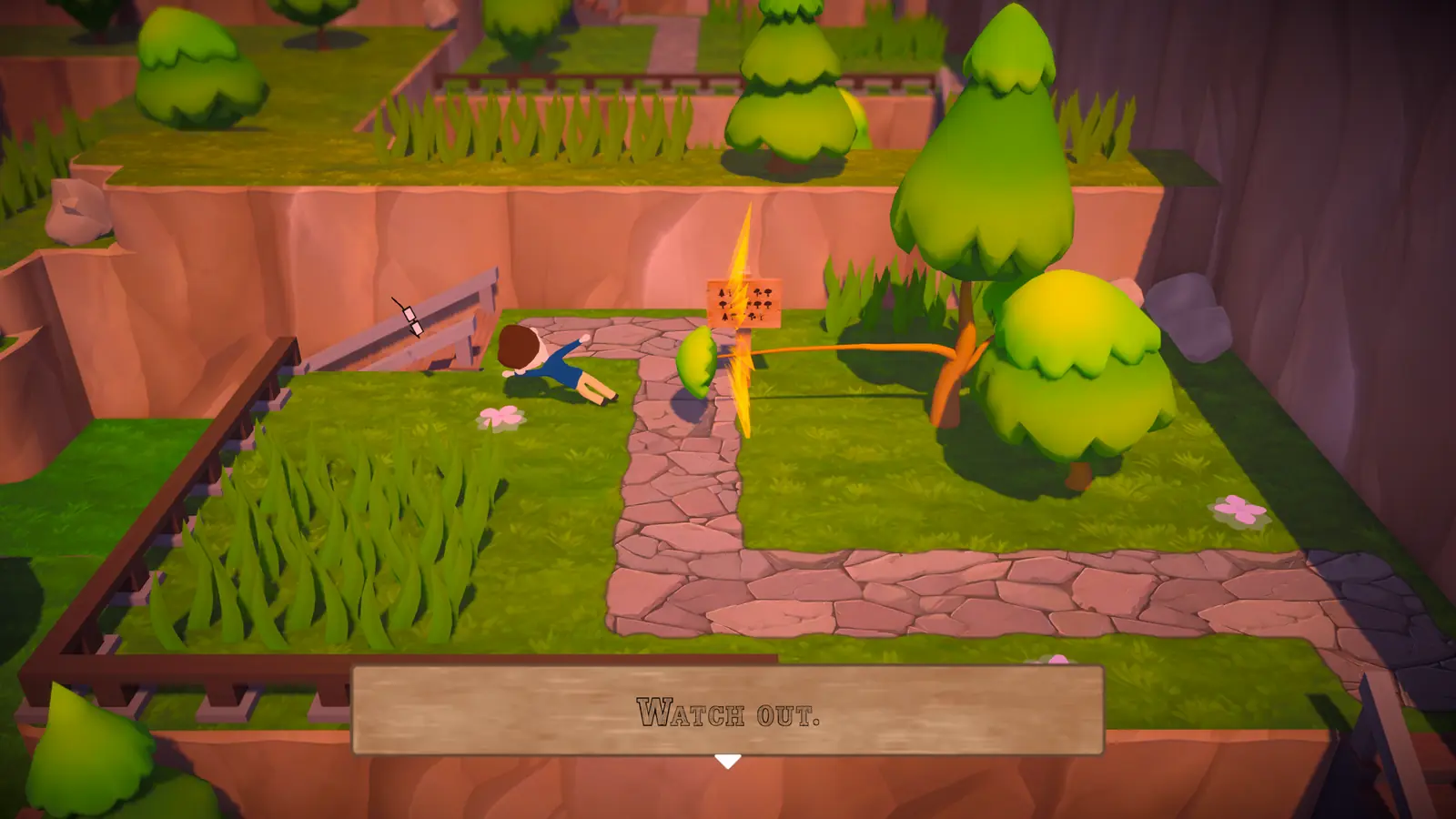
- "Watch out!" sign. Reading it is the trigger. The achievement WATCHOUT confirms this.
The WATCHOUT achievement is the clearest proof that the game treats reading as a mechanic: "Die while reading the 'Watch out!' sign." If you see that sign, read it from a distance and keep moving.
Chase and pursuit hazards
Chases are not about outrunning the tree. They are about not tripping.
- Following tree. Hides when you look at it, moves when you turn. Keep it in view and back away.
- Pursuing tree. Follows you through a root field. Do not stop for coins.
- Rolling sphere. Forces you into a recess. The sphere is the wall, not the enemy.
- Truck. Scripted. You cannot dodge it; it is the demo's ending gag.
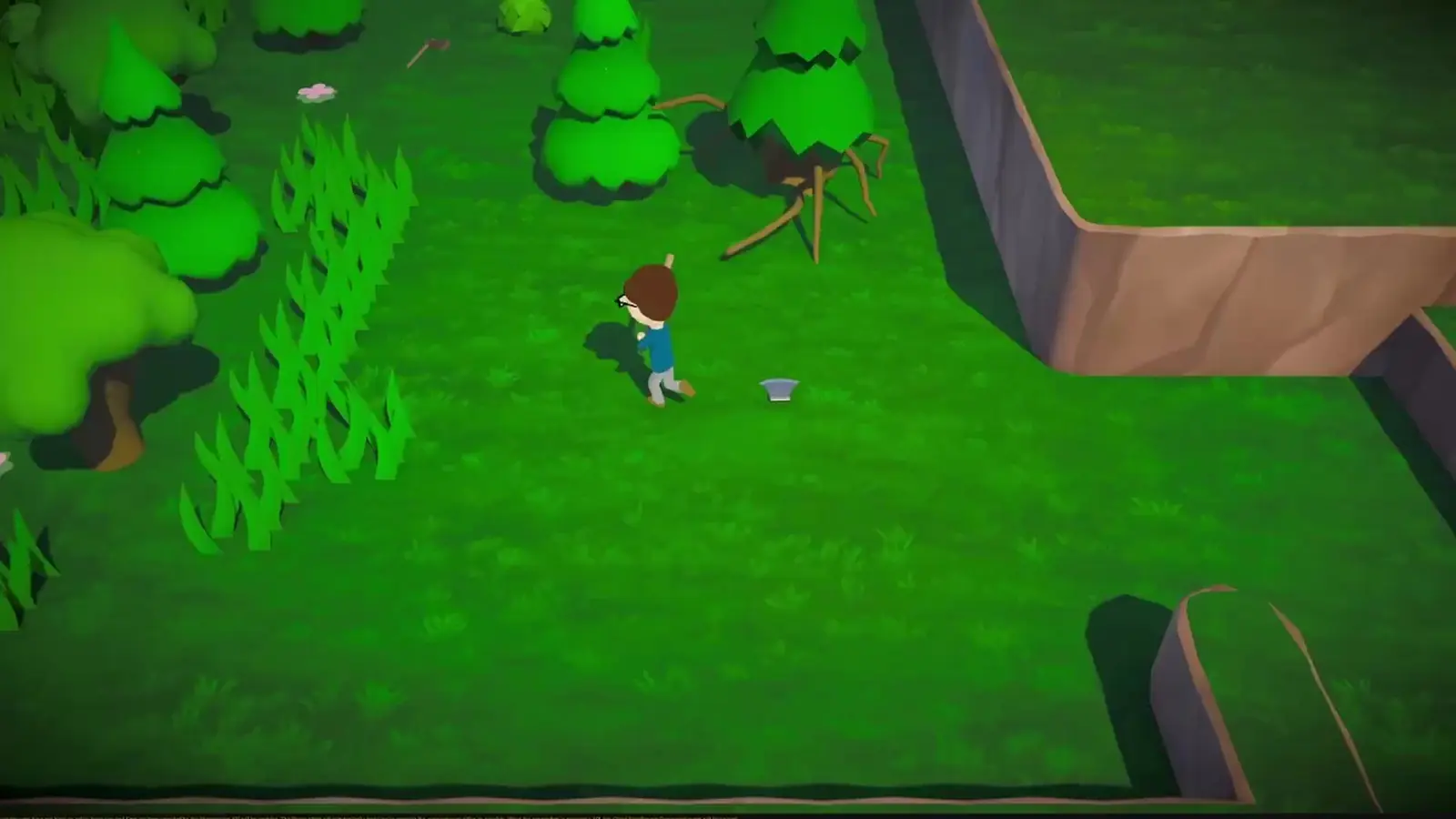
- Spider-leg trees. Trees and bushes grow legs and walk. They are slower than they look, but they block paths.
The spider-leg behavior is an official developer clip. The pursuit tree in the demo is also official. Neither can be fought; movement is the only answer.
Costume traps: presents, snowmen and scenery
The late game disguises traps as friendly objects.
- Chasing present. Flashes and beeps before chasing and exploding.
- Snowman tree. A snowman reveals itself as a tree and blocks the path.
- Christmas present key. A present contains a green key, then the trap triggers.
- Axe stump. The axe is pulled away as you reach for it.
- Bending axe. The axe bends around the player and traps them under a falling tree.
These are all from official clips. None of them is a boss; they are one-off gags with a tell. The tell is usually that the object is too convenient.
The final boss's traps
The final encounter is a set piece with spawned hazards rather than a single tree. Reviews describe visual clutter and hazards appearing under the player. Treat it as a sequence of the trap families above, played faster:
- Ground eruptions: watch the floor.
- Projectile volleys: keep moving laterally.
- Falling debris: use the outer edge.
- Add spawns: do not stand in the center.
There is no confirmed official name for the boss at launch. The endings page→ covers the story; the late-game traps page→ lists the encounter's observed patterns.
A practical trap checklist
Before you cross any new screen, ask:
- What is the most convenient object here?
- What is the most helpful sign saying?
- Where is the ground discolored?
- What sound is repeating?
- Where would I stand if I wanted to ambush someone?
If the answer to the first two is "a chest" and "this way," you are probably about to die. That is the game working as intended.
Official source: Trees Hate You on Steam ↗ — the store description's promise that the trees will trick, bully and hurt you.
FAQ
How many traps are in Trees Hate You? There is no official count. The game reuses a small set of mechanics across 14 levels, with new costumes and combinations. This page lists the families rather than a fake exact number.
Are the fan trap names official? No. Only a few names, such as tree-for-fall and Palm Tree Alley, come from the developer. The rest are community labels.
Can you disable traps? No. There is no accessibility toggle for traps. Challenge Mode adds more, not fewer.
Do traps change after death? In normal mode, some layouts and positions can change. Challenge Mode fixes them.
Which trap kills the most players? The public achievement percentages suggest the early palm and sign traps are the most common deaths, but those numbers reflect all players, not a controlled sample.
Sources
- Steam achievements ↗ — WATCHOUT, PALMTREEALLEY and related trap achievements.
- Official Tykenn FAQ ↗ — platforms and content policy.
- Steam update, June 19, 2026 ↗ — the tree-for-fall checkpoint.
- DualShockers review ↗ — late-game hazard behavior.